


International Technical Support Newsletter no 24, September 2025
- European projects PAS II ECOBUSAF and SOCSTAF: the final stretch
- Online presentation and training of trainers on the new version of the ERETES software
- Promoting innovation in African statistical systems: a game-changing post-hackathon study visit at INSEE!
- Evaluation missions for the ECOBUSAF and SOCSTAF projects in Mauritius and Côte d'Ivoire
- Encouraging the sharing of good practices in innovation in African public statistics
- Rwanda: discussions on the governance of the public statistical system
- Better assessing poverty and vulnerability in Mauritius
- Presentation of the Ines model to a Tunisian delegation
- Morocco: continued modernisation of the national accounts of the High Commission for Planning
- Support to improve the Turkish business register
- Presentation of Sirus to the National Statistics Office of Mongolia
- Strengthening cooperation with the National Institute of Statistics of Cambodia as part of the EU-funded twinning programme
- France attends the annual meeting of national institutes and statistical organisations from around the world
- Annual meeting of heads of statistical cooperation from the NSIs of EU Member States
European projects PAS II ECOBUSAF and SOCSTAF: the final stretch
With the ECOBUSAF and SOCSTAF projects coming to an end in late October 2025, many noteworthy activities took place during the first half of the year: several missions were carried out on the ERETES tool, both for its implementation in new countries (Liberia, Madagascar, Tunisia) and to test the new version (Senegal, Cape Verde). Two workshops were devoted to the development of this new version, which was presented to all users during an online workshop and was thoroughly reviewed during a training-of-trainers workshop. In the field of social statistics, the highlight was the study visit organised for the winners of the hackathon held in April 2024. A support mission on the implementation of informal employment monitoring also took place in Mbabane (Eswatini).
Finally, it is now time for the coordinators of the two projects (INSEE and Statistics Denmark) to begin evaluating the projects launched in spring 2022. An online survey is currently underway, while two evaluation missions have taken place in countries actively involved in the projects: Mauritius and Côte d'Ivoire.
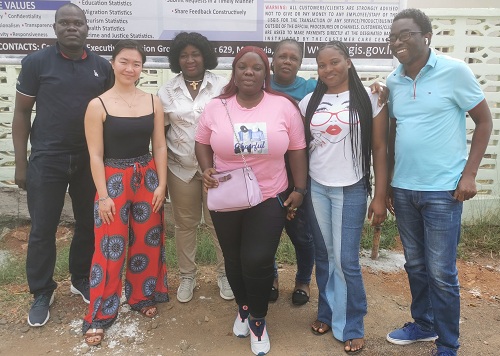
Representatives of the national accountants of the INS of Liberia and Alice Tchang (INSEE)
Online presentation and training of trainers on the new version of the ERETES software
An online presentation workshop, led by INSEE's ERETES technical team, was held over four half-days in February. This workshop brought together national accountants from twenty-six national statistical institutes in African Union countries that use ERETES, as well as experts from the World Bank, the International Monetary Fund, the African Development Bank and the West African Economic and Monetary Union Commission. Nearly 130 simultaneous connections were recorded at the peak of attendance, with numerous exchanges between the ERETES technical team and the experts participating in the workshop.
The new version of ERETES will soon be available in Portuguese and Arabic, in addition to French, English and Spanish. It will also offer several major improvements and new features in three areas:
- Semi-automatic balancing of supply-use-use balances to obtain a faster estimate of the gross domestic product (GDP) by the expenditure approach;
- Balance sheets, enabling user countries to reach the latest international benchmark for national accounts;
- Backcasting to recalculate and disseminate long series of annual national accounts more quickly, after a change of benchmark year.
To ensure the optimal deployment of the new version of ERETES, INSEE organised a training-of-trainers workshop in Tunis in May, in collaboration with the African Union Institute for Statistics (Ouvrir dans un nouvel ongletSTATAFRIC). This workshop brought together experts from the National Statistical Institutes of nine African countries (Benin, Cameroon, Cape Verde, Côte d'Ivoire, Guinea-Bissau, Morocco, Mauritania, Senegal and Togo) as well as national accounting experts from Statafric, the Economic and Statistical Observatory of Sub-Saharan Africa (Ouvrir dans un nouvel ongletAFRISTAT) and the African Development Bank.
These experts will be responsible for training teams of national accountants in their own countries before carrying out the same exercise in other user countries.
During the workshop, participants were able to learn in detail about the main improvements and the brand-new features brought by the new version of ERETES. Discussions also focused on scenarios for implementing the new version, the technical documentation to be produced and the adaptation of training courses to the specific needs of each country.
At the end of the workshop, a training certificate was presented to each trainee by Mr Adoum Gagoloum, Head of the Economic Statistics Division at Statafric.
Development and testing of the new version of ERETES will continue in 2025 before its rollout in early 2026.
Promoting innovation in African statistical systems: a game-changing post-hackathon study visit at INSEE!
From February 17th to 20th, a group of talented statisticians gathered at INSEE to celebrate the success of the 2024 PAS II-SOCSTAF hackathon. This initiative brought together the winning teams from the National Bureau of Statistics of Nigeria (Ouvrir dans un nouvel ongletNBS), the National Statistics Agency of Côte d'Ivoire (Ouvrir dans un nouvel ongletANStat), as well as representatives from the Ouvrir dans un nouvel ongletDirectorate of Agricultural Statistics of Benin and the National Institute of Statistics of Rwanda (Ouvrir dans un nouvel ongletNISR).
💡 During the visit, these teams had the unique opportunity to explore the cutting-edge work in alternative data processing carried out by INSEE and the statistical services of various ministries: Ouvrir dans un nouvel ongletDares - Ministry of Labour, General Commission for Sustainable Development (Ouvrir dans un nouvel ongletCGDD), Ouvrir dans un nouvel ongletMinistry of Agriculture. The main discussions focused on the use of information from text analysis, web scraping and data extraction from public administrative documents - innovations that could change the way we understand and use statistics around the world.
🚀 AT Ouvrir dans un nouvel ongletPARIS21, hackathon participants presented the innovative solutions they had developed, while PARIS21 shared its own innovations in the field of statistical transformation.
🔍 The visit ended with a collaborative workshop aimed at designing a methodological guide for organising future hackathons. This initiative is part of a broader effort to bring together best practices from across the African continent, building on Ouvrir dans un nouvel ongletNations Statistical Commission for Africa in 2024.
What are the key takeaways from this experience? African national statistical institutes are embarking on a path of major change - unlocking the full potential of alternative data sources, both administrative and private, to drive informed decisions and sustainable development.🌱

Participants in the post-hackathon visit, representing ANSD in Côte d'Ivoire, NBS in Nigeria, INSTaD in Benin, Statistics Norway and INSEE
Evaluation missions for the ECOBUSAF and SOCSTAF projects in Mauritius and Côte d'Ivoire
The coordinators of the SOCSTAF (Statistics Denmark) and ECOBUSAF (INSEE) projects conducted two evaluation missions to Statistics Mauritius (Mauritius) and the National Statistics Agency of Côte d'Ivoire (ANStat). The objective was to measure the contributions of the PAS II project components to these two institutes, which are engaged in various activities.
Statistics Mauritius participated in activities to strengthen business registers through its participation in multi-country workshops, bilateral expert missions and hosting a study visit. The institute also presented its work on tourism satellite accounts at seminars and attended several online training courses.
ANStat, for its part, received support in setting up regional economic accounts and overhauling its employment monitoring system, including a quarterly survey. It was also among the top two winners of the 2024 hackathon, which enabled it to conduct a study visit to INSEE on the use of alternative data sources.
Both institutes expressed great satisfaction with their participation in the projects. They highlight the richness of the exchanges with European experts and the concrete benefits of their involvement: improvement of the directory for Statistics Mauritius, autonomous production capacity for regional accounts for ANStat. They also welcomed the wide range of training courses offered by INE-Spain, while acknowledging the lack of motivation to participate in these sometimes demanding online courses and expressing the need for more structured support, combining distance learning, face-to-face sessions and individualised support.
Beyond the technical gains, these projects lay the foundations for ambitious South-South cooperation based on the sharing of experiences between African peers. They also highlight common challenges: mobilising administrative data for official statistical purposes, developing satellite and regional accounts, managing data and structuring processes via the GSBPM, and promoting hackathons as a tool for steering, innovation and capacity building.
Encouraging the sharing of good practices in innovation in African public statistics
In collaboration with the Economic and Statistical Observatory of Sub-Saharan Africa (Ouvrir dans un nouvel ongletAFRISTAT), INSEE organised a study visit in April on innovation in public statistics in Africa. In addition to presenting several French public laboratories, including INSEE's Ouvrir dans un nouvel ongletSSP Lab, this event provided an opportunity to discuss training and research in this field at the École nationale de la statistique et de l'analyse de l'information (Ouvrir dans un nouvel ongletENSAE) and the Groupe des écoles nationales d'économie et statistique (Ouvrir dans un nouvel ongletGenes) and to exchange views on practices, difficulties and strategic choices. In addition to the National Statistics Agency of Côte d'Ivoire (Ouvrir dans un nouvel ongletANStat), whose delegation attended in person, Ouvrir dans un nouvel ongletthe INS of Cameroon, Ouvrir dans un nouvel ongletthe African Development Bank and the National Agency for Statistics and Demography of Senegal (Ouvrir dans un nouvel ongletANSD) participated remotely. The Director General of INSEE also received his counterparts from Afristat and the National Statistics Agency of Côte d'Ivoire.
One of the aims of the event was to encourage networking among peers, which is essential for innovation.

From left to right: Olivier Biau, Head of the Statistical and International Coordination Department (INSEE), Thiekoro Doumbia, Director General of ANStat, Jean-Luc Tavernier, Director General of INSEE, and Paul-Henri Nguema Meye, Director General of Afristat.
Rwanda: discussions on the governance of the public statistical system
In January and February, at the request of the National Institute of Statistics of Rwanda (Ouvrir dans un nouvel ongletNISR), a series of three video workshops was organised to present the organisation of the French public statistical system to the senior management of the Rwandan institute. During these sessions, presentations by the National Council for Statistical Information, the Label Committee and the Public Statistics Authority led to discussions on how these bodies operate in practice, their legal framework and the organisation of their work.
Better assessing poverty and vulnerability in Mauritius
In April 2025, INSEE participated in the second phase of a project, the result of a collaboration between Ouvrir dans un nouvel ongletExpertise France and Ouvrir dans un nouvel ongletMaurice Stratégie, which aims to better characterise poverty and vulnerability in Mauritius using public statistics data. Following an initial mission in 2024, the INSEE expert, accompanied by an economist from the University of Mauritius, presented and facilitated the application of an indirect means test as a targeting method to identify the poorest households. This method, which has proven its worth in other African contexts, was tested on local data, making it possible to assess living standards using observable and verifiable variables.
Presentation of the Ines model to a Tunisian delegation
In January, the Ines microsimulation model was presented to a Tunisian delegation composed of representatives from the Ministry of Economy and Planning and the Tunisian Institute for Competitiveness and Quantitative Studies (Ouvrir dans un nouvel ongletITCEQ). This visit to Paris was part of the European Ouvrir dans un nouvel ongletSavoirs-Eco project in Tunisia, in which INSEE is involved. It aimed to support discussions on the reform of the decision-making and forecasting models currently used by these institutions and included, in addition to INSEE, exchanges with the Directorate-General of the Treasury, France Stratégie and the French Development Agency.
Morocco: continued modernisation of the national accounts of the High Commission for Planning
A mission to Rabat has extended the significant progress made since 2023 with INSEE on Morocco's national accounts: balance sheets and the digital economy. For the former, INSEE's National Accounts Department provided the High Commission for Planning (HCP) with the computer program for the permanent inventory model, facilitating the assessment of fixed assets produced during the expert mission, after adapting the program to the Moroccan context. Progress on all balance sheets is aimed at estimating assets at the end of 2014 by the end of the year. A generalisation phase, this time based on 2022, should be able to start in 2026.
With regard to the digital economy, by the end of 2025, the HCP should have a first version of a satellite account for 2014. In particular, it would include tables relating to the "users" and "producers", the assessment of national expenditure on the digital economy as a proportion of GDP but also in terms of added value and employment.
This was the fourth mission carried out at the HCP as part of the project.
Support to improve the Turkish business register
As part of a European project, an INSEE mission was held in April at Ouvrir dans un nouvel ongletTurkStat, Turkey's national statistics institute, focusing on statistics and business registers. Particular emphasis was placed on the similarities between French (and European) and Turkish registers, as well as on the identification of groups in relation to their potential for improving the registers. It was emphasised that profiling, for which the French methodology presented aroused great interest, is TurkStat's long-term objective.
Presentation of Sirus to the National Statistics Office of Mongolia
The Sirus business directory was presented to the Ouvrir dans un nouvel ongletNational Statistics Office of Mongolia. Although the Office currently uses economic censuses, it now wishes to rely more on administrative sources, particularly for the next census, scheduled for 2026. Discussions with INSEE aimed to explore this avenue and learn about the advantages of an inter-administrative directory such as Sirus. In addition to this, discussions also focused on the integration of administrative data and profiling.
Strengthening cooperation with the National Institute of Statistics of Cambodia as part of the EU-funded twinning programme
Three key missions and one visit were carried out as part of efforts to strengthen the capacity of Cambodia's national statistical system. These activities were part of a European twinning programme with the National Institute of Statistics of Cambodia (Ouvrir dans un nouvel ongletNIS), led by Istat (Italy). INSEE plays a key role as the lead agency for Component 1, dedicated to NIS governance and coordination of the Cambodian statistical system. These missions have enabled progress to be made on several strategic areas, ranging from the development of data exchange agreements to the definition of NIS dissemination and communication strategies.
In February and then May, two missions were carried out, first to lay the groundwork for formalising data exchanges between the NIS and ministerial departments: a detailed inventory of data received and transmitted by the various NIS departments was drawn up. The missions then enabled the drafting of exchange agreements, for which a constructive dialogue was initiated with two partner ministries: the Ministry of Education, Youth and Sports, and the Ministry of Economy and Finance. These discussions facilitated a better understanding of each party's expectations and constraints with regard to statistical data.
In June, the third mission focused on two complementary areas: firstly, analysing the functioning of existing thematic working groups and identifying new ones; and secondly, defining dissemination and communication strategies tailored to different user groups. This integrated approach aims to enhance the visibility of statistical outputs and improve their uptake.
Finally, also in June, INSEE hosted a delegation from the NIS. The meeting aimed to consolidate institutional partnerships and share practices in statistical governance, in a context where the NIS organisation has undergone a profound transformation since the beginning of 2025.
🔍 Over five days, the discussions were rich and constructive. INSEE teams and several players in the French public statistical system shared their experiences on :
- the internal organisation of the Institute (decision-making, programming, management training),
- communication,
- innovative projects,
- relations between INSEE and ministerial statistical services,
- the central role of the CNIS and the ASP.
👥 The delegation was also received by the Ouvrir dans un nouvel ongletDREES (Ministry of Health), which presented its work and its cooperation with INSEE, as well as by Ouvrir dans un nouvel ongletVital Strategies, an international NGO based in Paris, a partner of the NIS on vital statistics.
The visit was marked by lively discussions, the sharing of expertise and a common desire to strengthen the quality and governance of statistical systems.

From left to right: Mr Lay Chhan, Deputy Director General of the NIS, HE Try Ritthea, Director General of the NIS, Jean-Luc Tavernier, Director General of INSEE, Oriana Daniele, Resident Adviser for the twinning with the NIS, Olivier Biau, Head of the Statistical and International Coordination Department, and Dominique Francoz, Head of the Governance Component of the twinning with the NIS (INSEE).

Representatives from Cambodia's NIS and INSEE
France attends the annual meeting of national institutes and statistical organisations from around the world
France, represented by INSEE, attended the 56th meeting of the United Nations Statistical Commission in New York (4–7 March). Highlights included the adoption of the SNA 2025, which provides a modernised framework incorporating digitalisation and environmental issues, notably recognising data as an asset; the valuation of natural resources and the inclusion of their depletion costs in the calculation of net domestic product. The 2025-2034 population census cycle, known as the "2030 Census", was also validated. The previous 2020 cycle was impacted by the health crisis, with a global coverage rate of 85% (204 countries surveyed), a decrease of 8 points and 10 countries fewer than in 2010.
Another highlight was the approval of the mandate of the Advisory Committee on Fundamental Principles of Official Statistics, designed to strengthen compliance with these principles worldwide. Inspired by the European Statistical Governance Advisory Board (Ouvrir dans un nouvel ongletESGAB), this committee will be tasked with examining cases of non-compliance with these principles.
Finally, the Commission addressed many other topics, including the growing importance of data science. France is actively contributing to this international dynamic with the establishment of an Onyxia body within the Ouvrir dans un nouvel ongletUnited Nations Global Data Platform. This meeting also promoted exchanges and partnerships within the framework of INSEE's cooperation activities with several national statistical institutes (Jordan, Morocco, Moldova, Mongolia, Oman, etc.), as well as with international and regional organisations such as Statafric, the World Bank and the United Nations Economic Commissions for Latin America and the Caribbean and for Africa.
Annual meeting of heads of statistical cooperation from the NSIs of EU Member States
INSEE recently took part in the annual meeting of heads of international technical cooperation from the national statistical institutes (NSIs) of EU Member States, as well as candidate and neighbouring countries in Europe. This event provided an excellent opportunity to take stock of the latest developments at Eurostat and within the European statistical system, as well as the current dynamics surrounding the EU's eastern neighbourhood.
Among the major topics discussed, the progress of the accession processes of the candidate countries – Moldova, Ukraine, Montenegro, Serbia and Albania – was widely debated, particularly with regard to statistical cooperation with these countries. This cooperation also extends to a wider sphere, including European Neighbourhood countries, as well as regions in Central Asia, the Middle East, North Africa and sub-Saharan Africa. Particular focus was placed on collaboration between the NSIs of the Baltic countries, highlighting the importance of joint work and enhanced communication for the implementation of cooperation actions.
The event also provided an opportunity to take stock of new initiatives in statistical capacity building: INSEE presented the hackathon organised as part of the Pan-African Statistics Programme (PAS II). Finally, the NSIs of Ukraine and Albania shared their recent experiences, highlighting the impact of major crises on statistical production: in Ukraine, the armed conflict has profoundly affected their work, while in Albania, a cyberattack in January 2024 severely disrupted the NSI's IT infrastructure.
This meeting thus demonstrated the vitality and solidarity of the enlarged European statistical network, which continues to adapt to current geopolitical and technological challenges.